Tuesday, April 21, 2020

MuleSoft Certified Platform Architect - Level 1 Exam Questions

Want to pass MuleSoft Certified Platform Architect - Level 1 Exam? PassQuestions new updated MCPA-Level 1 MuleSoft Certified Platform Architect - Level 1 Exam Questions which include the latest and most accurate information about MuleSoft Certified Platform Architect - Level 1 exam.It ensure you have a good preparation for your exam and help you pass your MCPA-Level 1 certification exam successfully in your first attempt.
What Is MuleSoft Certified Platform Architect - Level 1?

The MuleSoft Certified Platform Architect - Level 1 exam validates that an architect has the required knowledge and skills to direct the emergence of an effective application network out of individual integration solutions following API-led connectivity across an organization using Anypoint Platform. S/he should be able to:
  • Optimize and shape the Anypoint Platform deployment in the specific organizational context, working with business, infrastructure, InfoSec, and other teams.
  • Define how Anypoint Platform is used in conjunction with other tools and applications in the organization.
  • Define the usage of Anypoint Platform and the corresponding organizational and process changes needed to help the Platform be sustainable.
  • Provide guidance and drive creation of standards, reusable assets, and automation required for scale and multi-LOB adoption.

MuleSoft Certified Platform Architect - Level 1 Exam Overview

Format: Multiple-choice, closed book, proctored online or in a testing center
Length: 58 questions
Duration: 120 minutes (2 hours)
Pass score: 70%
Language: English
Cost: $375
The exam can be taken a maximum of 5 times, with a 24 hour wait between each attempt.

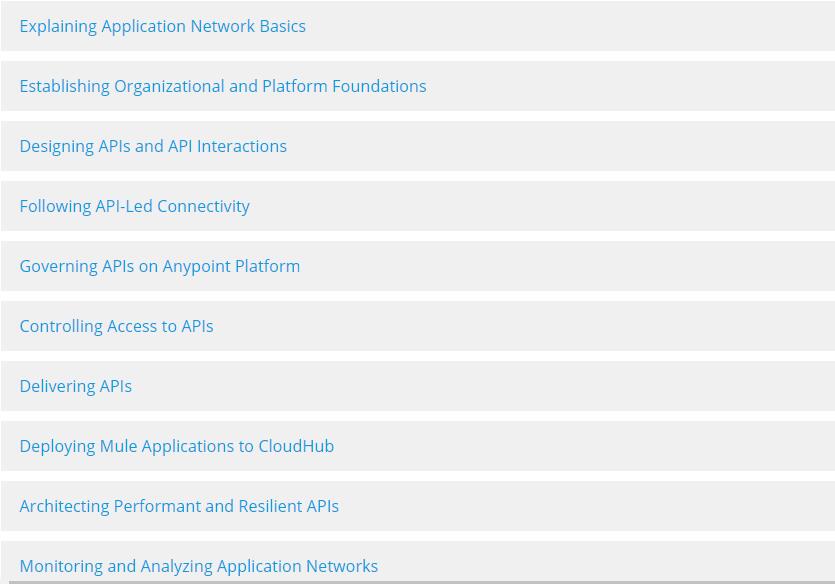
MuleSoft Certified Platform Architect - Level 1 Exam Topics

The exam validates that the candidate can perform the following tasks.

View Online MuleSoft Certified Platform Architect - Level 1 Free Questions

1.What API policy would LEAST likely be applied to a Process API?
A. Custom circuit breaker
B. Client ID enforcement
C. Rate limiting
D. JSON threat protection
Answer: A
2.What is a key performance indicator (KPI) that measures the success of a typical C4E that is immediately apparent in responses from the Anypoint Platform APIs?
A. The number of production outage incidents reported in the last 24 hours
B. The number of API implementations that have a publicly accessible HTTP endpoint and are being managed by Anypoint Platform
C. The fraction of API implementations deployed manually relative to those deployed using a CI/CD tool
D. The number of API specifications in RAML or OAS format published to Anypoint Exchange
Answer: B
3.An organization is implementing a Quote of the Day API that caches today's quote.
What scenario can use the CloudHub Object Store via the Object Store connector to persist the cache's state?

A. When there are three CloudHub deployments of the API implementation to three separate CloudHub regions that must share the cache state.
B. When there are two CloudHub deployments of the API implementation by two Anypoint Platform business groups to the same CloudHub region that must share the cache state.
C. When there is one deployment of the API implementation to CloudHub and another deployment to a customer-hosted Mule runtime that must share the cache state.
D. When there is one CloudHub deployment of the API implementation to three CloudHub workers that must share the cache state.
Answer: C
4.What condition requires using a CloudHub Dedicated Load Balancer?
A. When cross-region load balancing is required between separate deployments of the same Mule application
B. When custom DNS names are required for API implementations deployed to customer-hosted Mule runtimes
C. When API invocations across multiple CloudHub workers must be load balanced
D. When server-side load-balanced TLS mutual authentication is required between API implementations and API clients
Answer: B
5.What do the API invocation metrics provided by Anypoint Platform provide?
A. ROI metrics from APIs that can be directly shared with business users
B. Measurements of the effectiveness of the application network based on the level of reuse
C. Data on past API invocations to help identify anomalies and usage patterns across various APIs
D. Proactive identification of likely future policy violations that exceed a given threat threshold
Answer: C
6.What is true about the technology architecture of Anypoint VPCs?
A. The private IP address range of an Anypoint VPC is automatically chosen by CloudHub.
B. Traffic between Mule applications deployed to an Anypoint VPC and on-premises systems can stay within a private network.
C. Each CloudHub environment requires a separate Anypoint VPC.
D. VPC peering can be used to link the underlying AWS VPC to an on-premises (non AWS) private network.
Answer: B

New Azure Developer AZ-204 Exam Questions

The AZ-204 exam is new released and replace the AZ-203 Developing Solutions for Microsoft Azure exam which will be retired on August.Once a candidate passes either the AZ-203 or AZ-204 exam they will earn the Microsoft Certified: Azure Developer Associate certification. PassQuestion provides the latest Azure Developer AZ-204 Exam Questions which cover all the exam topics and objectives and will prepare you for success quickly and efficiently. We regularly update the AZ-204 questions and answers to make sure you always gain access to the most current product.

AZ-204 Exam Description - Developing Solutions for Microsoft Azure

The new AZ-204 beta exam is the ideal choice for any individual aspiring to become a cloud developer on Azure. The AZ-204 exam is suitable for candidates who want to participate in all stages of development, starting from requirements definition. Candidates for this exam also have to contribute to the design, development, deployment, and maintenance of solutions on Microsoft Azure. 
The AZ-204 Developing Solutions for Microsoft Azure certification exam tests and validates your expertise as an Azure Developer. This exam tests your expertise across all phases of the Microsoft Azure development process; from solution design, to development and deployment, to testing and maintenance.

AZ-204 Exam Skill Measured

Develop Azure compute solutions (25-30%)
Develop for Azure storage (10-15%)
Implement Azure security (15-20%)
Monitor, troubleshoot, and optimize Azure solutions (10-15%)
Connect to and consume Azure services and third-party services (25-30%)

View Developing Solutions for Microsoft Azure AZ-204 Free Questions

1.Note: This question is part of a series of questions that present the same scenario. Each question in the series contains a unique solution that might meet the stated goals. Some question sets might have more than one correct solution, while others might not have a correct solution.
After you answer a question in this section, you will NOT be able to return to it. As a result, these questions will not appear in the review screen.
You develop a software as a service (SaaS) offering to manage photographs. Users upload photos to a web service which then stores the photos in Azure Storage Blob storage. The storage account type is General-purpose V2.
When photos are uploaded, they must be processed to produce and save a mobile-friendly version of the image. The process to produce a mobile-friendly version of the image must start in less than one minute.
You need to design the process that starts the photo processing.
Solution: Convert the Azure Storage account to a BlockBlobStorage storage account.
Does the solution meet the goal?

A. Yes
B. No
Answer: B
2.You are developing an application that uses Azure Blob storage.
The application must read the transaction logs of all the changes that occur to the blobs and the blob metadata in the storage account for auditing purposes. The changes must be in the order in which they occurred, include only create, update, delete, and copy operations and be retained for compliance reasons.
You need to process the transaction logs asynchronously.
What should you do?

A. Process all Azure Blob storage events by using Azure Event Grid with a subscriber Azure Function app.
B. Enable the change feed on the storage account and process all changes for available events.
C. Process all Azure Storage Analytics logs for successful blob events.
D. Use the Azure Monitor HTTP Data Collector API and scan the request body for successful blob events.
Answer: B
3.You are developing a web app that is protected by Azure Web Application Firewall (WAF). All traffic to the web app is routed through an Azure Application Gateway instance that is used by multiple web apps. The web app address is contoso.azurewebsites.net.
All traffic must be secured with SSL. The Azure Application Gateway instance is used by multiple web apps.
You need to configure the Azure Application Gateway for the app.
Which two actions should you perform? Each correct answer presents part of the solution.
NOTE: Each correct selection is worth one point.

A. In the Azure Application Gateway’s HTTP setting, enable the Use for App service setting.
B. Convert the web app to run in an Azure App service environment (ASE).
C. Add an authentication certificate for contoso.azurewebsites.net to the Azure Application gateway.
D. In the Azure Application Gateway’s HTTP setting, set the value of the Override backend path option to contoso22.azurewebsites.net.
Answer: AD
4.You need to store the user agreements.
Where should you store the agreement after it is completed?

A. Azure Storage queue
B. Azure Event Hub
C. Azure Service Bus topic
D. Azure Event Grid topic
Answer: B
5.You develop Azure solutions.
You must connect to a No-SQL globally-distributed database by using the .NET API.
You need to create an object to configure and execute requests in the database.
Which code segment should you use?

A. new Container(EndpointUri, PrimaryKey);
B. new Database(Endpoint, PrimaryKey);
C. new CosmosClient(EndpointUri, PrimaryKey);
Answer: C

Friday, April 3, 2020

Java SE 11 Programmer I 1Z0-815 Exam Questions

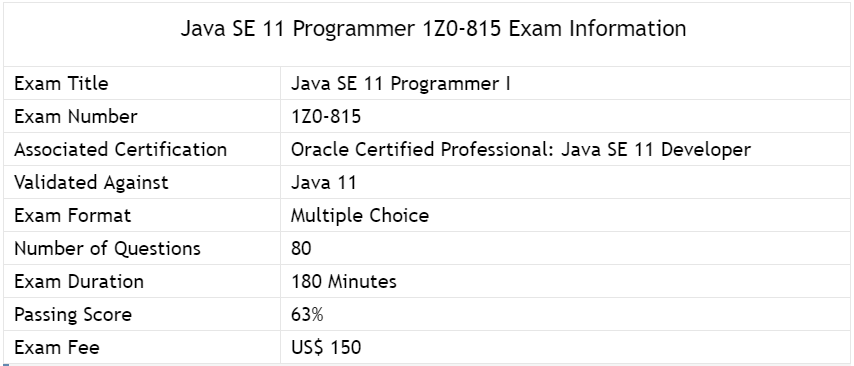
To ensure that you're effectively preparing for the 1Z0-815 exam, PassQuestion new updated Java SE 11 Programmer I 1Z0-815 Exam Questions to help you master the 1Z0-815 Certification knowledge by clearly showing you the key points and real questions required in the exam. You are guaranteed to pass the first step for your Oracle Certified Professional: Java SE 11 Developer Certification.

1Z0-815 Exam Overview - Java SE 11 Programmer I

Java SE 11 Programmer 1Z0-815 exam involves the candidate answering a total of 80 multiple choice-based questions within the duration of 180 minutes (3 hours). To pass the examination and gain the certification, the participating candidate needs to score at least 63% of the total marks. This means that out of the 80 questions, to pass the examination, a candidate has to answer 51 questions correctly at a minimum. The registration fee for the 1Z0-815 certification exam is US$150 currently. 
To gain the Oracle Certified Professional title, you require to attempt and pass both Java SE 11 Programmer I 1ZO-815 and Java SE 11 Programmer II 1Z0-816 examinations. If you’ve already passed the 1ZO-815 exam, you should start the 1Z0-816 exam preparation.

Java SE 11 Programmer I 1Z0-815 Exam Objectives

Understanding Java Technology and environment
Working With Java Primitive Data Types and String APIs
Working with Java Arrays
Creating and Using Methods
Reusing Implementations Through Inheritance
Handling Exceptions
Creating a Simple Java Program
Using Operators and Decision Constructs
Describing and Using Objects and Classes
Applying Encapsulation
Programming Abstractly Through Interfaces
Understanding Modules

View Online 1Z0-815 Free Questions From PassQuestion Java SE 11 Programmer I 1Z0-815 Full Questions

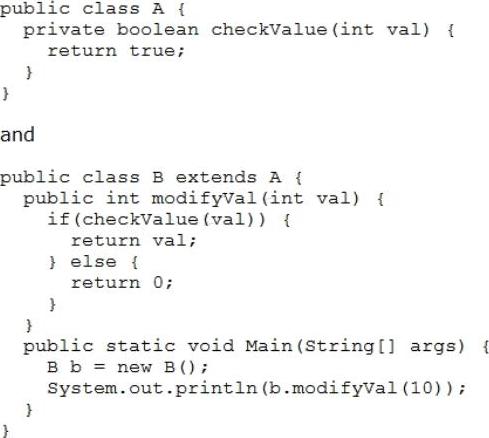
1.Given:
What is the result?
A. nothing
B. It fails to compile.
C. 0
D. A java.lang.IllegalArgumentException is thrown.
E. 10
Answer: B 
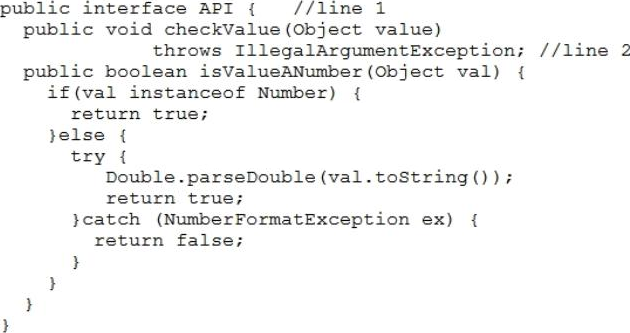
2.Given:
Which two changes need to be made to make this class compile? (Choose two.)
A. Change Line 1 to an abstract class:public abstract class API {
B. Change Line 2 access modifier to protected:protected void checkValue(Object value)throws IllegalArgumentException;
C. Change Line 1 to a class:public class API {
D. Change Line 1 to extend java.lang.AutoCloseable:public interface API extends AutoCloseable {
E. Change Line 2 to an abstract method:public abstract void checkValue(Object value)throws IllegalArgumentException;
Answer: C,E 
3.Which two modules include APIs in the Java SE Specification? (Choose two.)
A. java.logging
B. java.desktop
C. javafx D. jdk.httpserver
E. jdk.jartool
Answer: A,D
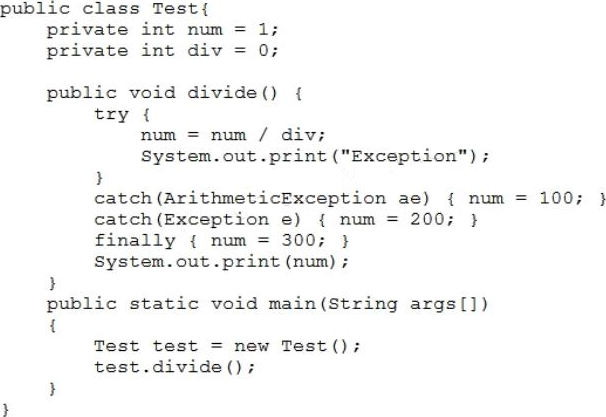
4.Given:
What is the output?
A. 300
B. Exception
C. 200
D. 100
Answer: A
5.Which two statements are true about the modular JDK? (Choose two.)
A. The foundational APIs of the Java SE Platform are found in the java.base module.
B. An application must be structured as modules in order to run on the modular JDK.
C. It is possible but undesirable to configure modules’ exports from the command line.
D. APIs are deprecated more aggressively because the JDK has been modularized.
Answer: A,B 
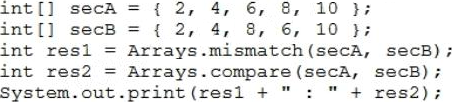
6.Given the code fragment:
What is the result?
A. -1 : 2
B. 2 : -1
C. 2 : 3
D. 3 : 0
Answer: A

DELL EMC DES-1721 Practice Test Questions

PassQuestion new updated DELL EMC DES-1721 Practice Test Questions which save your valuable time and energy and allow you to easily and smoothly pass the Specialist - Implementation Engineer SC Series Exam in the first try.Selecting PassQuestion DELL EMC DES-1721 Practice Test Questions will increase your confidence of passing the exam and will effectively help you pass the DES-1721 exam. PassQuestion can provide you with a very high accuracy of exam preparation.

DES-1721 Exam Overview - Specialist - Implementation Engineer SC Series Exam 

DES-1721 exam is a qualifying exam for the Specialist - Implementation Engineer, SC Series track. This exam focuses on the knowledge and activities involved in installing, initializing, configuring and testing the hardware and software of the Dell EMC SC Series Storage products. There are totally 60 questions in the real test and you need to answer all questions in 90 minutes,the passing score is 63.

DES-1721 Exam Topics Covered In Real Test

Storage Center Fundamentals (5%)
Storage Center Hardware (15%)
Storage Center Cabling (19%)
Storage Center Deployment and Initial Configuration (3%)
Initial SAN HBA and Switch Configurations (11%)
Storage Center Basic Administration (15%)
Dell Storage Manager (DSM) Installation and Configuration (9%)
Dell Storage Manager (DSM) Administration (6%)
Storage Center Data Progression, Data Instant Replay, and Remote Instant Replay Management (17%)

View DES-1721 Free Questions Comes From PassQuestion Full DELL EMC DES-1721 Exam Questions 

1.You are installing a new SC9000.
Which procedure should be used to install and configure the system?

A. Connect through the iDRAC port
B. Connect through a null modem cable to the serial port
C. Connect through the Dell Storage Manager Client
D. Connect through the supplied proprietary serial cable to the serial port
Answer: D
2.An administrator wants to configure an SC Series array to use Virtual Port Mode.
What is a requirement to accomplish this task?

A. NPIV must be disabled on Fibre Channel switches
B. I/O Controller cards must use a single-ID firmware version
C. Fibre Channel switches must use a switched fabric topology
D. Activation license must be purchased and installed
Answer: D
3.What are the possible methods to upgrade the firmware on a Brocade switch?
A. FTP, SFTP, and Web Tools
B. USB, FTP, and SFTP
C. USB, FTP, and Web Tools
D. USB, SFTP, and Web Tools
Answer: C
4.A customer is running the Dell Storage Manager (DSM) Suite as a software stack on Microsoft Windows. To reduce the Microsoft licensing costs, the customer wants to switch to the DSM Virtual Appliance.
Which recommended deployment should the customer use?

A. Configure as a Primary Data Collector
B. Configure as a Remote Data Collector
C. Migrate the DSM database manually
D. Migrate from the existing Data Collector
Answer: D
5.Which operating system runs the Dell Storage Manager (DSM) as a virtual appliance?
A. CentOS 7
B. Windows Server 2012 R2 
C. VMware
D. Windows Server 2010 R2
Answer: C
6.Which best practices should be followed when using iSCSI to connect SC Series arrays and hosts for switches that incorrectly negotiate speed and duplex?
A. Use a separate supernet or switches for iSCSI trafficGigabit full duplex hard set for all iSCSI portsEnsure switches used for iSCSI are of a blocking design
B. Use a separate VLAN or switches for iSCSI trafficAuto-negotiate for all switchesEnsure switches used for iSCSI are of a non-blocking design
C. Use a separate VLAN or switches for iSCSI trafficGigabit full duplex hard set for all iSCSI portsEnsure switches used for iSCSI are of a non-blocking design
D. Use a separate subnet or switches for iSCSI trafficAuto-negotiate for all switchesEnsure switches used for iSCSI are of a blocking design
Answer: C

Friday, March 27, 2020

DELL EMC ISM V4 DEA-1TT4 Real Exam Questions

DEA-1TT4 Associate - Information Storage and Management Version 4 Exam is a qualifying exam for the Associate - Information Storage and Management (DCA-ISM) certification.To keep pace with real DEA-1TT4 ISM V4 Exam, PassQuestion new updated DELL EMC ISM V4 DEA-1TT4 Real Exam Questions. It is the latest version for ensuring that you can pass EMC DEA-1TT4 exam in the first try. So we highly recommend that if you are preparing for your DEA-1TT4 exam, please choose our real EMC ISM V4 DEA-1TT4 questions online to study.

DEA-1TT4 Associate - Information Storageand Management Version 4 Exam Overview

DEA-1TT4 exam focuses on information storage and management in a data center. It includes third platform technologies, intelligent storage systems, software-defined storage, storage networking technologies, and various business continuity options– along with security and management of a storage infrastructure. A limited number of questions refer to product examples that are used in the training to reinforce the knowledge of technologies and concepts.

DELL EMC ISM V4 DEA-1TT4 Exam Topics Covered In The DEA-1TT4 Real Test

Modern Data Center Infrastructure (15%)
• Describe the data classification, elements of a data center, key characteristics of a data center, and key technologies driving digital transformation 
• Explain the cloud characteristics, cloud service models, and cloud deployment models
• Explain the key characteristics of big data, components of a big data analytics solution, Internet of Things (IoT), machine learning, and artificial intelligence (AI)
• Describe the building blocks of a modern data center
• Describe a compute system, storage, connectivity in a data center, application, and options to build a modern data center
Storage Networking Technologies (20%)
• Describe Storage Area Network (SAN), FC architecture, FC topologies, zoning, and virtualization in FC SAN
• Describe TCP/IP, IP SAN, iSCSI protocol, components, connectivity, addressing, discovery domains, and VLAN
• Explain the components and connectivities of FCIP and FCoE
Storage Systems (26%)
• Explain the components of an intelligent storage system, RAID, erasure coding, data access methods, scale-up and scale-out architectures
• Explain the components of block-based storage system, storage provisioning, and storage tiering mechanisms
• Explain the NAS components and architecture, NAS file sharing methods,  and file-level virtualization and tiering
• Describe object-based storage device components, functions, operations, and unified storage architecture
• Describe software-defined storage attributes, architecture, functions of the control plane, software-defined extensibility, and software-defined networking functionalities
Backup, Archive, and Replication (24%)
• Describe the information availability measurements and key fault tolerance techniques
• Explain backup granularity, architecture, backup targets, operations, and backup methods
• Describe data deduplication and data archiving solutions architecture
• Describe replication uses, and replication and migration techniques
Security and Management (16%)
• Describe the information security goals, terminologies, various security domains, and threats to a storage infrastructure
• Explain key security controls to protect the storage infrastructure
• Describe the storage infrastructure management functions and processes

View DELL EMC ISM V4 DEA-1TT4 Free Questions Online Before Ordering PassQuestion Real DEA-1TT4 Exam Questions

1.What is an accurate statement about Governance?
A. Restrict access to certain users
B. Ensure removal of security risks
C. Authorize policy-making decisions
D. Demonstrate adherence to polices
Answer: C
2.A company is using an intrusion detection and prevention system (IDPS) to scan and analyze intrusion events.
Which IDPS technique uses a database that contains known attack patterns?

A. Role-based
B. Profile-based
C. Signature-based
D. Anomaly-based
Answer: C
3.An Ethernet switch has eight ports and all ports must be operational for 24 hours, from Monday through Friday.
However, a failure of Port4 occurs as follows:
• Monday = 8 PM to 9 PM
• Wednesday 7 PM to 9 PM
• Thursday = 6 AM to 9 AM
• Saturday = 4 PM to 7 PM
What is the MTTR of Port 4?

A. 2 hours
B. 3 hours
C. 28 hours
D. 38 hours
Answer: A
4.What accurately describes an iSCSI HBA?
A. Performs both iSCSI and TCP/IP processing
B. Requires CPU cycles for TCP/IP processing
C. Requires a software adapter with built-in functionality
D. Enables transmission of data through iSCSI tunneling
Answer: A
5.When using the erasure coding technique in an object-based storage system, data is divided into 12 data segments and 4 coding segments.
What is the maximum number of disk drive failures against which data is protected by the configuration?

A. 3
B. 4
C. 8
D. 12
Answer: A
6.What is a key advantage of cloning a virtual machine (VM)?
A. Ability to run new VMs simultaneously with the same IP address.
B. Reduces the time required to create multiple copies of a VM.
C. Improves the performance of an existing VM and new VMs.
D. Eliminates the need to create multiple snapshots for a VM.
Answer: B

CCNP Enterprise 300-425 ENWLSD Exam Questions

300-425 Designing Cisco Enterprise Wireless Networks v1.0 exam is new Cisco exam associated with the CCNP Enterprise and Cisco Certified Specialist - Enterprise Wireless Design certifications. PassQuestion new released Cisco CCNP Enterprise 300-425 ENWLSD Exam Questions which contains 61 questions and answers to help you pass your Cisco 300-425 exam successfully and get your CCNP Enterprise certification in an easy way.

Requirement For CCNP Enterprise Certification - a core exam and an enterprise concentration exam

To earn CCNP Enterprise, you pass two exams: a core exam and an enterprise concentration exam of your choice. And every exam in the CCNP Enterprise program earns an individual Specialist certification, so you get recognized for your accomplishments along the way. The core exam is 350-401 ENCOR Implementing and Operating Cisco Enterprise Network Core Technologies (ENCOR),300-425 ENWLSD is a enterprise concentration exam that you can take to achieve your CCNP Enterprise Certification. 

What Covered Are Covered In CCNP Enterprise 300-425 ENWLSD Exam?

1.0 Wireless Site surveys
1.1 Collect design requirements and evaluate constraints
  • 1.1.a Client density
  • 1.1.b Real time applications
  • 1.1.c AP type
  • 1.1.d Deployment type (data, location, voice, video)
  • 1.1.e Security
1.2 Describe material attenuation and its effect on wireless design
1.3 Perform and analyze a Layer 1 site survey
1.4 Perform a pre-deployment site survey
1.5 Perform a post deployment site survey
1.6 Perform a predictive site survey
1.7 Utilize planning tools and evaluate key network metrics (Ekahau, AirMagnet, PI, Chanalyzer, Spectrum Analyzer)
2.0 Wired and Wireless Infrastructure
2.1 Determine physical infrastructure requirements such as AP power, cabling, switch port capacity, mounting, and grounding
2.2 Determine logical infrastructure requirements such as WLC/AP licensing requirements based on the type of wireless architecture
2.3 Design radio management
  • 2.3.a RRM
  • 2.3.b RF profiles
  • 2.3.c RxSOP
2.4 Apply design requirements for these types of wireless networks
  • 2.4.a Data
  • 2.4.b Voice and video
  • 2.4.c Location
  • 2.4.d Hyperlocation
2.5 Design high-density wireless networks and their associated components (campus, lecture halls, conference rooms)
2.6 Design wireless bridging (mesh)
  • 2.6.a Modes of operation
  • 2.6.b Ethernet bridging
  • 2.6.c WGB and roaming
3.0 Mobility
3.1 Design mobility groups based on mobility roles
3.2 Optimize client roaming
3.3 Validate mobility tunneling for data and control path
4.0 WLAN high availabilit
4.1 Design high availability for controllers
  • 4.1.a Network availability through LAG
  • 4.1.b Stateful Switchover (SSO)
  • 4.1.c Anchor controller priority and redundancy
4.2 Design high availability for APs
  • 4.2.a AP prioritization
  • 4.2.b Fall-back (assigning primary, secondary, and tertiary)

View Online 300-425 ENWLSD Free Questions Selected From PassQuestion 300-425 ENWLSD Full Questions

1.A network engineer is preparing for an office site survey with a height of 2.5 meters.
Which three components are recommended to complete the survey? (Choose three.)

A. Use a battery pack to power APs
B. Use a drawing of the office space to draw AP and client placements.
C. Use DoS attack on APs while measuring the throughput.
D. Use APs with directional antennas.
E. Use APs with external antennas.
F. Use APs with built-in antennas.
Answer: ABF
2.Which UDP port numbers are used for exchange mobility packets in an AireOS wireless deployment?
A. UDP 16666 for control plane, EoIP (IP protocol 97) for data plane
B. UDP 16668 for control plane, UDP 16667 for data plane
C. UDP 16667 for control plane, UDP 16666 for data plane
D. UDP 16666 for control plane, UDP 16667 for data plane
Answer: D
3.A customer asks an engineer to explain the concept of mobility domains and mobility groups.
Which statement does the engineer respond with?

A. A mobility group does not constrain the distribution of security context of a client and also does not constrain AP fail-over between controllers when the WLC are in the same mobility domain.
B. If WLCs are in the same mobility domain, they communicate with each other but, if an anchor WLC is present it must be in the same mobility domain for communication to be possible.
C. If WLCs are in the same mobility domain, they communicate with each other. Mobility groups constrain the distribution of security context of a client and also constrain AP fail-over between controllers.
D. WLCs do not need to be in the same mobility domain to communicate with each other. Mobility groups constrain the distribution of security context of a client and also constrain AP fail-over between controllers.
Answer: C
4.An engineer is designing a wireless deployment for a university auditorium.
Which two features can be used to help deal with the issues introduced by high AP count? (Choose two.)

A. TSPEC
B. RXSOP
C. TPC
D. LSS
E. DFS
Answer: CE
5.A wireless engineer is designing a wireless network to support real-time applications over wireless.
Which IEEE protocol mus the engineer enable on the WLC so that the number of packets that are exchanged between an access point and client are reduced and fast roaming occurs?

A. 802.11w
B. 802.11r
C. 802.11i
D. 802.11k
Answer: D
6.A network administrator of a global organization is collapsing all controllers to a single cluster located in central Europe.
Which concern must addressed?

A. Some channels may not be available consistently across the organization.
B. Different RF policies per office are not available in this configuration.
C. Syslog must be configured to the time-zone of the NMS platform.
D. Centralized controllers cannot uniformly authenticate global users.
Answer: C
7.An engineer must ensure that the new wireless LAN deployment can support seamless roaming between access points using a standard based on an amendment to the 802.11 protocol.
Which protocol must the engineer select?

A. 802.11i
B. 802.11ac
C. 802.11r
D. 802.11e
Answer: C
8.A high-density wireless network is designed.
Which Cisco WLC configuration setting must be incorporated in the design to encourage clients to use the 5 GHz spectrum?

A. Band Select
B. RRM
C. Cisco Centralized Key Management
D. load balancing
Answer: A